

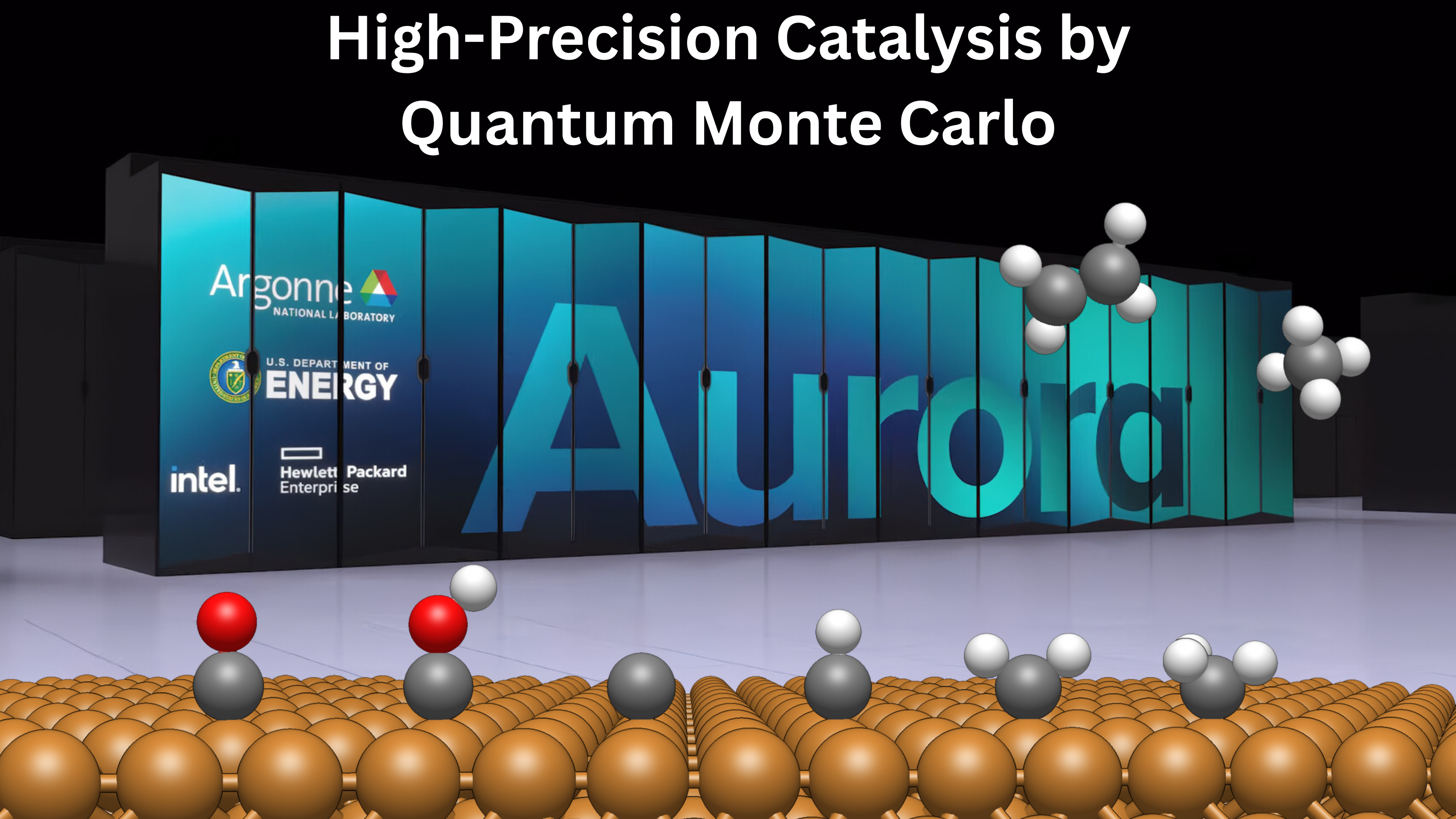
Exceptional Success: One Million Node-Hours for Quantum Catalysis Research
Matúš Dubecký (University of Ostrava) has become part of an elite international collaboration, which also includes our former student Roman Fanta (Stanford University / SLAC National Laboratory), together with Michal Bajdich (Stanford University / SLAC National Laboratory) and Prof. Luboš Mitaš (North Carolina State University). The team has achieved remarkable success by securing a prestigious award in the DOE ASCR Leadership Computing Challenge (ALCC). They were granted substantial computing time on two leading-edge U.S. supercomputers—specifically, 1,000,000 node-hours on Aurora, currently ranked as the third most powerful computer in the world, powered by nearly 64,000 Intel Max GPUs and delivering a peak performance exceeding 2 exaflops (that’s more than 2 billion billion calculations per second!), as well as 150,000 node-hours on the highly advanced system Polaris.
🎯 What exactly is the project about?
Their awarded project, entitled HIGH-PRECISION HETEROGENEOUS CATALYSIS BY QUANTUM MONTE CARLO, aims to reach chemical accuracy (≤ 1 kcal/mol) in computational modeling of catalytic reactions critical to sustainable energy and climate protection. Using the powerful Quantum Monte Carlo (QMC) method implemented in QMCPACK, they will overcome the known shortcomings of current computational methods, especially Density Functional Theory (DFT). The project will focus on important catalytic systems, including CO adsorption and related intermediates for CO₂ reduction on copper, key oxygen evolution and reduction reactions (OER/ORR) on RuO₂ catalysts, and advanced single-atom catalysts (Fe-N₄-C).
The outcomes will serve as definitive reference data, guiding the improvement of DFT functionals and training advanced machine learning models. Thanks to the unprecedented power of Aurora—representing the cutting edge of exascale computing—these calculations will be performed at scales previously unimaginable. Additionally, the team will develop novel pseudopotentials, more efficient memory algorithms, and openly share their data via the Catalysis-Hub.org platform.
🔌 Why does it matter?
Aurora’s unparalleled computing power will allow an unprecedented level of detail in modeling complex catalytic reactions, dramatically accelerating the discovery and optimization of environmentally friendly catalysts essential for clean energy technologies.
Wish us luck—exascale computing is now powering breakthroughs in catalysis! 💪⚛️