

Nová publikace se spoluautorstvím Masouda Shahrokhiho!
Spin-Controlled Electro- and Photocatalysis: Principles, Modeling, and Enhancement Strategies
Odkaz zde: https://doi.org/10.1039/D6DT00917D
Abstrakt:
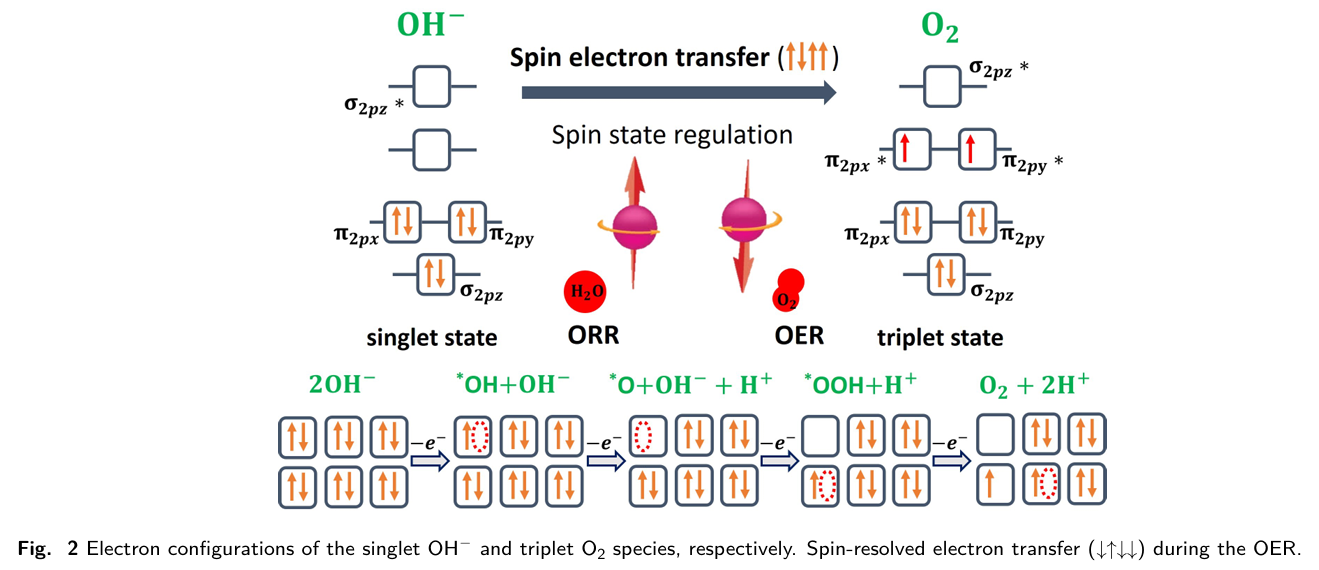
Electron-spin-based investigations using density functional theory (DFT) methods, which play a significant role in the development of catalytic approaches, are lacking in the literature. Meanwhile, advances in photo- and electro-driven catalytic processes rely not only on industrial-scale development and experimental validation, but also on rigorous, fundamental investigations based on DFT to pinpoint the origins of key challenges and how to overcome them. This review provides a comprehensive overview of recent progress in spin-resolved density functional theory and its application to the investigation of (photo)electrocatalytic mechanisms and materials. Therefore, in this article, we discuss electron-spin-based concepts, including spin polarization and its role in catalytic applications; the application of strain; the introduction of external electric fields; and the integration of multiple control techniques. Additionally, we review advanced exchange–correlation approaches, including GGA, LDA+U, and hybrid functionals such as HSE, which improve the accuracy of band gap calculations and enable a more reliable description of spin polarization, magnetic ordering, and spin-dependent electronic structures. Commonly used DFT software for studying electrochemical and photocatalytic materials is also presented to guide both computational and experimental researchers. Among these tools, VASP and CASTEP are most frequently employed. Regarding computational methods, the GGA framework—especially the PBE functional and hybrid GGA–HSE approach—is widely applied, whereas studies using LDA or LDA+U are relatively limited in this field. In particularly the GW approximation, the DFT exchange–correlation potential is replaced by a nonlocal, energy-dependent self-energy, which not only corrects band-gaps but also modifies spin polarization, magnetic ordering, band dispersions and effective masses, affecting charge carriers mobility and recombination—key factors for photocatalytic efficiency. By critically assessing current progress, this review intends to highlight promising avenues for future research in harnessing electron spin control to unlock new potentials in photocatalytic applications.