

Nová publikace se spoluautorstvím Masouda Shahrokhiho!
Hetero[8]circulene-Based 2D Materials: A DFT Study of Electronic, Mechanical, and Transport Properties
Odkaz zde: https://doi.org/10.1021/acsaem.5c03121
Abstrakt:
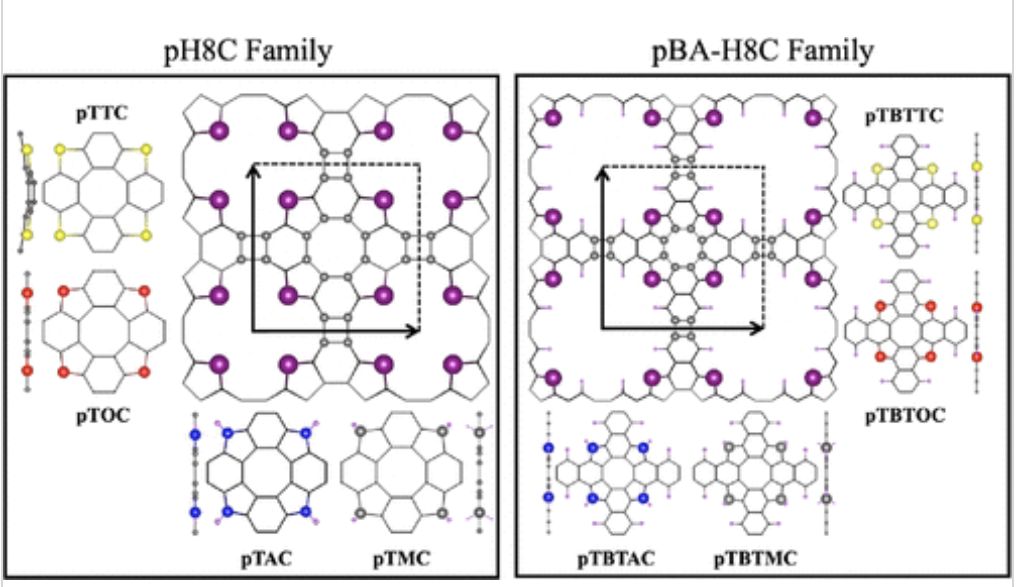
Two-dimensional (2D) covalent organic frameworks (COFs) with nanoporous structures are a promising platform for high-performance semiconductors. Building on the recent experimental synthesis of 2D polymeric tetraoxa[8]circulene (pTOC) (Liu, F.; Yan, Y.; Tang, W.; Qie, B.; Chen, J.; Wang, Z.; Louie, S. G.; Fischer, F. R. Orbital Engineering Band Degeneracy in a Dual-Square Carbon-Oxide Framework. ACS Nano 2025, 19 (15), 15139–15147. https://doi.org/10.1021/acsnano.5c03671), we computationally designed a series of seven 2D polymers based on hetero[8]circulene (pH8C) and its benzannulated derivative (pBA-H8C). Using density functional theory (DFT) and machine-learned interatomic potentials, we systematically evaluated their stability, mechanical properties, and electronic structure. The results identify two distinct electronic families: narrow-gap pH8C semiconductors (0.15–0.60 eV) and wider-gap pBA-H8C semiconductors (1.79–2.14 eV). This electronic divergence leads to contrasting charge transport behavior: pH8C frameworks exhibit high electron mobility, while pBA-H8C frameworks show more balanced electron and hole transport. All structures possess strong visible-light absorption and robust mechanical properties that are largely independent of the heteroatom identity. This study establishes 2D circulene-based polymers as a versatile materials class for flexible optoelectronics and energy conversion technologies.