

Nová publikace se spoluautorstvím Daniela Tunegy!
Exploring 2,4,6-trinitrotolulene and α/γ-Al2O3 energetic composite stability − A first principles approach
Odkaz zde: https://doi.org/10.1016/j.apsusc.2026.168153
Abstrakt:
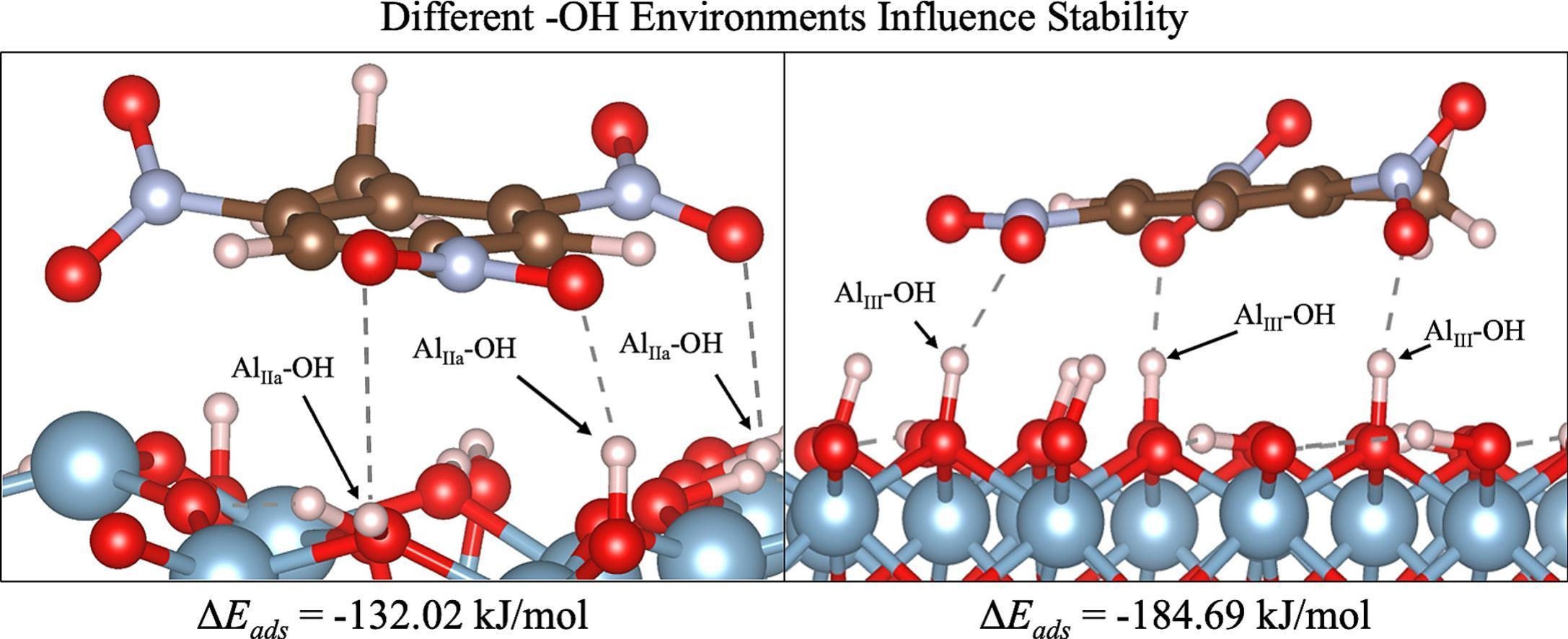
The adsorption of 2,4,6-trinitrotoluene (TNT) on γ-Al2O3 and α-Al2O3 surfaces is investigated using density functional theory (DFT) to understand the thermodynamic role at the TNT–Al2O3 interface on TNT energetic performance. Since Al2O3 passivates aluminum particles commonly combined with TNT, their interfacial chemistry fundamentally influences composite storage stability, aging, and reactivity. Four periodic slab models of γ-Al2O3 and α-Al2O3 are employed to evaluate TNT adsorption in parallel and perpendicular orientations. Structural, energetic, electronic, and thermodynamic properties are analyzed to determine adsorption stability. Among all configurations, adsorption on γ-Al2O3 Plane B’ is identified as the most energetically and thermodynamically stable, with an adsorption energy (ΔEads) of −184.7 kJ/mol. This enhanced stability is associated with multiple strong-to-moderate –NO2···H–O hydrogen bonds formed between TNT nitro groups and surface hydroxyl groups. Thermochemical analyses reveal exothermic adsorption along with orientation and temperature dependent spontaneity. Bader charge analysis shows interfacial charge redistribution, particularly at surface −OH groups involved in the strongest interactions. Overall, parallel adsorption configurations are more stable than perpendicular ones, and γ-Al2O3 surfaces exhibit greater adsorption stability than α-Al2O3. These findings provide molecular-level insight into TNT–Al2O3 interactions and their potential influence on energetic performance and TNT degradation in aluminum-based composites.