

Jiří Kalmár, Talha Kalsoom a František Karlický publikovali nový článek!
Dimensionality-driven colossal excitons in semiconducting yttrium carbide (MXene)
Odkaz zde: https://doi.org/10.1016/j.cartre.2026.100642
Abstrakt:
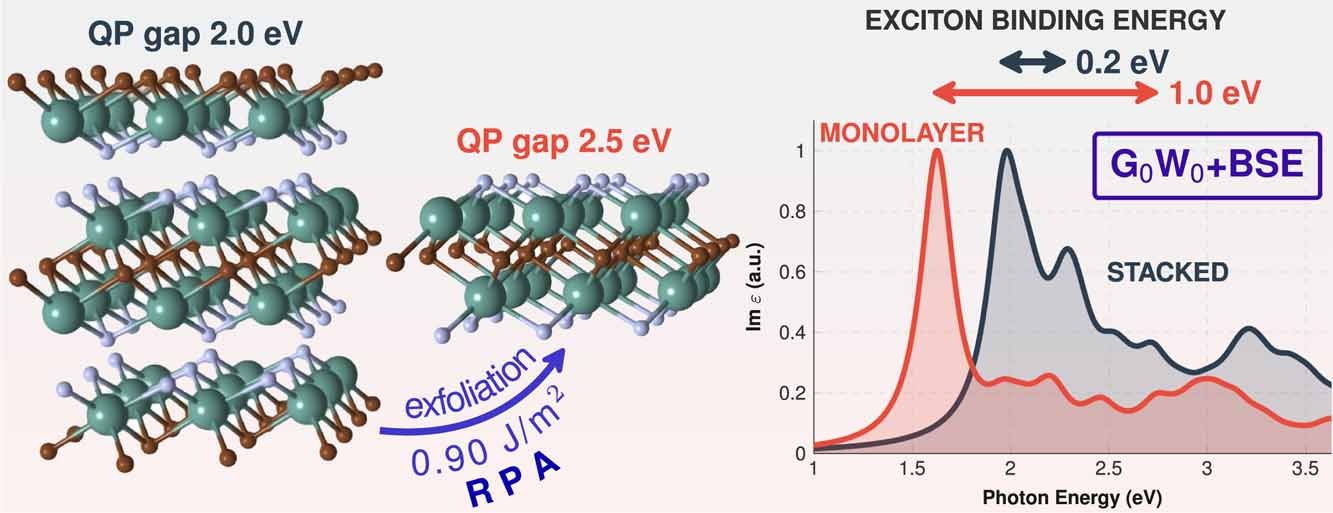
The recent synthesis of stoichiometric Y2CF2 marks a paradigm shift in the MXene family, offering a pristine, semiconducting alternative to the metallic and surface-disordered variants typically produced via acid etching. Here, we employ state-of-the-art many-body perturbation theory (RPA and GW+BSE) to unravel the quasiparticle electronic structure and excitonic properties of both the stacked bulk crystal and its unexplored monolayer form. Our energetic analysis establishes the dynamical and thermal stability of the monolayer but reveals a substantial exfoliation energy of J/m. We attribute this strong interlayer coupling, significantly higher than in typical van der Waals materials, to a unique interplay of interlayer dispersive and intralayer electrostatic forces, further evidenced by a high out-of-plane stiffness. Consequently, liquid-phase or intercalation-assisted techniques will be essential for isolating single sheets. Electronically, the bulk crystal exhibits a distinct asymmetry in out-of-plane charge carrier dispersion. While electrons show partial 3D mobility, the strict 2D confinement of holes drives an overall quasi-2D excitonic nature. However, dimensional reduction to the monolayer amplifies many-body effects, widening the quasiparticle band gap and simultaneously redshifting the optical gap from 2.0 eV to 1.7 eV. This shows the optical response is dominated by excitonic effects, transitioning from weakly bound excitons in the bulk, with an exciton binding energy of 0.2 eV, to tightly bound excitonic states in the monolayer with a colossal binding energy of 1.0 eV. Driven by spatial confinement and reduced dielectric screening, this value significantly exceeds standard scaling laws for 2D semiconductors. These findings establish Y2CF2 as a robust platform for room-temperature excitonic physics, positioning it as a promising candidate for next-generation optoelectronic and flexible nanodevices.