

New Publication Co-Authored by Masoud Shahrokhi!
Cl-adsorption drives band engineering beyond oxygen-vacancy-induced band-gap narrowing in TiO2 photocatalysis: experimental and DFT insights
Link here: 10.1016/j.apsusc.2026.168185
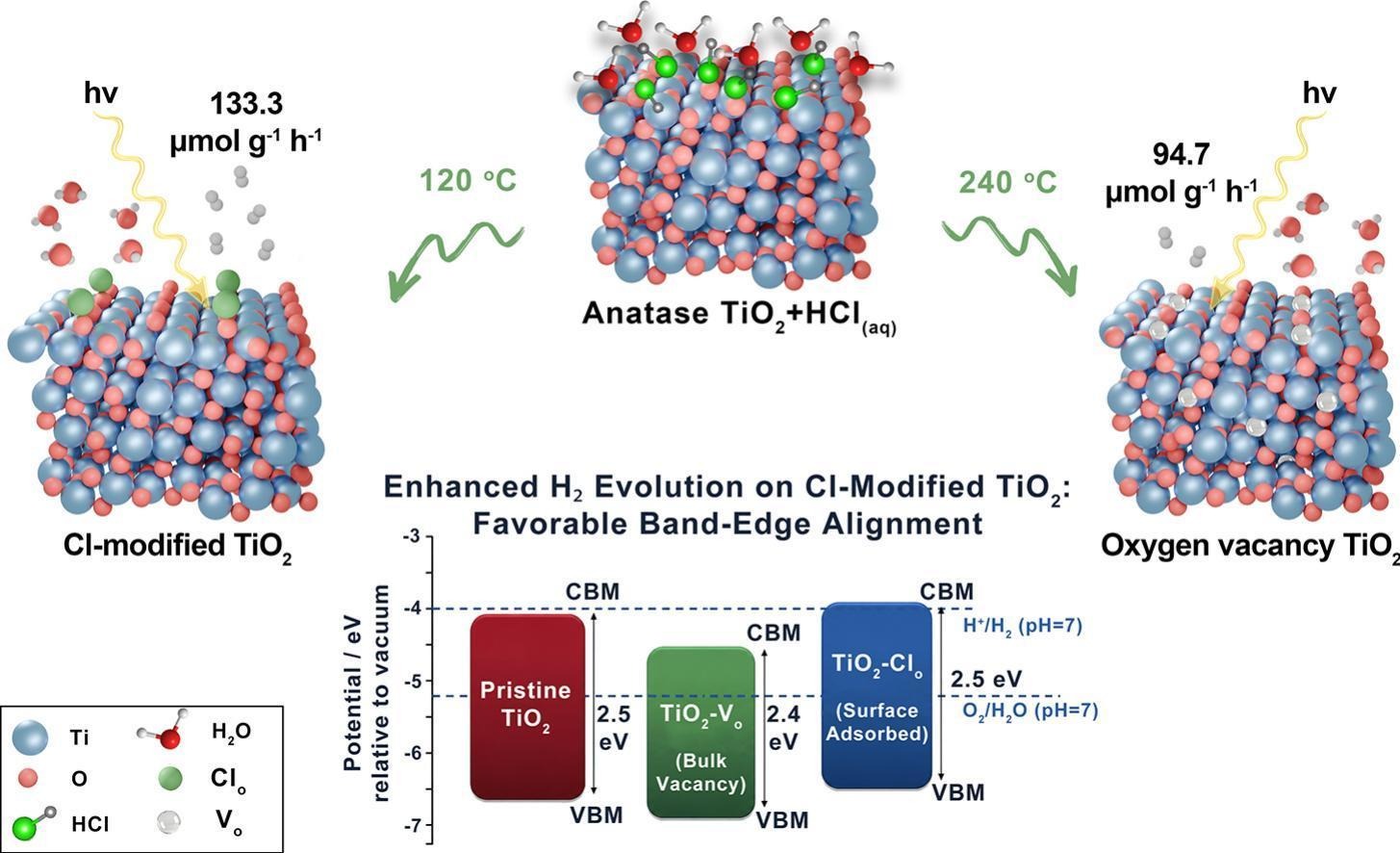
Abstract:
Although band gap narrowing via defect states can improve light absorption in photocatalysts, it may also impair charge transfer. Here, we show that in anatase TiO2, HCl treatment and thermal processing generate two distinct surface states: Cl-modified anatase with an Eg = 3.18 eV, and oxygen-vacancy-rich TiO2 exhibiting visible-light absorption and Eg = 3.02 eV. Despite enhanced light harvesting, the vacancy-rich sample shows only moderate solar-driven H2 evolution (∼94.7 μmol h−1 g−1) from aqueous methanol, indicating that the vacancy-rich defect state generated here is not the optimal configuration for photocatalytic H2 evolution. In contrast, Cl-modified anatase achieves the highest activity (∼133.3 μmol h−1 g−1) without a cocatalyst, outperforming pristine TiO2 (∼7.3 μmol h−1 g−1) and P25 under identical conditions. DFT calculations reveal that band gap narrowing is consistent with contributions from bulk-like oxygen-vacancy states, whereas surface vacancies are expected to influence band-edge alignment more strongly. At the same time, surface-adsorbed Cl preserves the band gap but repositions both band edges to straddle the H+/H2 and H2O/O2 levels when referenced on the aqueous pH 7 scale. Reaction-pathway analysis further reveals slightly favorable hydrogen-evolution energetics on Cl-modified surfaces. Separately, the OER was assessed solely by DFT, which predicts a fully downhill reaction pathway on Cl-adsorbed TiO2 under simulated illumination, unlike oxygen-vacancy-containing TiO2, which retains non-spontaneous reaction steps.